The business of building materials in India has evolved from a labor-intensive craft into a field of high-precision engineering. As the nation’s developers shift toward rapid construction technologies to meet the housing deficit, the demand for high-strength fly-ash bricks and concrete blocks has reached record levels. In 2026, the competitive landscape has changed; to survive and thrive, the modern entrepreneur must look toward full automation as the cornerstone of their business strategy.
Efficiency Through Advanced Machinery
The primary competitive edge in today’s B2B market comes directly from the technical capability of your concrete block machine. Modern units are no longer just “presses”; they are integrated ecosystems designed to handle abrasive industrial materials while maintaining high-speed output.
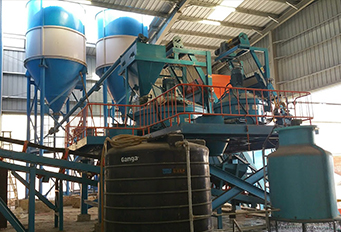
- Precision Mixing and Material Handling: Integrated Pan Mixers ensure the exact chemical and physical ratio of fly ash, sand, lime, and gypsum. In a manual setup, human error often leads to weak batches. Automation ensures that every fly-ash brick has the same structural integrity as the last.
- Zero-Waste Manufacturing Logic: High-quality machines allow for “Green Block Recycling.” If a block doesn’t meet initial density checks, it can be immediately recycled back into the mixer before it sets. This ensures nearly 100% material utilization, directly padding your profit margins.
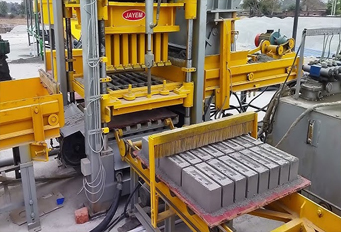
- Standardized Quality via Hydraulics: Automated high-frequency vibrations coupled with high-pressure hydraulics ensure that fly-ash bricks and concrete blocks meet rigorous structural codes. When your machine consistently delivers $100$ tons of pressure, you eliminate the risk of product rejection from high-end construction sites.
Overcoming the Labor and Logistics Challenge
With labor shortages becoming a chronic issue in industrial hubs like Punjab, Haryana, and Karnataka, relying on manual labor is a significant business risk. A fully automatic brick manufacturing machine offers a “plug-and-play” solution that stabilizes your production schedule.
These modern plants come equipped with PLC (Programmable Logic Controller) Touchscreens. These interfaces allow operators to monitor production metrics in Hindi, English, or regional languages, ensuring ease of use for the local workforce. By reducing the need for specialized manual skill sets, automation minimizes human error and ensures that the brick manufacturing machine price pays for itself through increased uptime, consistency, and reduced overhead.
Strategic Market Positioning in 2026
In the current real estate climate, being a mere “supplier” is no longer enough. To secure long-term contracts with Tier-1 developers, you must position yourself as a “technology partner.” By utilizing a high-tonnage fly ash brick making machine, you can provide the certified compressive strength data required for massive infrastructure projects, such as coastal roads, bridges, and smart-city townships.
Furthermore, the uniformity of concrete blocks produced by automated plants allows for faster masonry on-site. Developers save money on plastering and labor, making your product the preferred choice over inconsistent, locally made alternatives.
Conclusion
The transition to fly-ash bricks and concrete blocks is more than an environmental trend; it is the inevitable future of Indian masonry. By adopting fully automated production lines and high-pressure hydraulic technology, manufacturers can ensure sustainable growth, high-volume output, and a significant return on investment. In the evolving Indian realty landscape, technology is the only bridge to true scalability.